

1968 RNZAF Operational Orientation Course
Firstly, some background on ‘me’!
Having applied to the RNZAF in 1965 to train as a pilot, I attended an Aircrew Personnel-Selection (Persel) course at RNZAF Station Wigram, as it was then named, in August 1965. At the end of that selection process I was told that my academic qualifications, to a standard of ‘only’ School Certificate level after 3 years at high school, would not be adequate for me to handle the ‘Wings course’ academic requirements. Disappointed, of course, I subsequently accepted an offer from the RNZAF to be an ‘Administration and Supply – Secretarial’ (A&S – Sec) officer. Accordingly, I reported to Wigram on 11th January 1966 (11 Jan 66) to undertake some 10-weeks of RNZAF officer training, as a member of the No 44 Course intake, at the Officer Training School (OTS) of Ground Training Wing (GTW), Wigram. Later, having successfully completed OTS training on 18 Apr 66, I was posted to RNZAF Base Ohakea with effect from 19 Apr 66 as a Secretarial officer to the position of Flight Commander (Flt Cdr) Services Flight.
At that time at Ohakea, Number (No.) 75 Sqn was equipped with de Havilland (DH) Vampire T11 two-seat, and Vampire FB5 single-seat jet fighter aircraft. No. 42 Squadron was equipped with the Douglas DC3 Dakota, the DH Devon and two North American Harvards. No.14 Squadron had the Canberra B (i) 12 (B12) medium bomber and were based at RAF Tengah, Singapore, as part of the Far East Air Force (FEAF) during the unsettled period of ‘Confrontation’ with Indonesia. Conversion courses for pilots and navigators onto the Canberra were conducted at Ohakea by the small Strike Support Unit (SSU) that had both the Canberra T13 trainer and the Canberra B12.
Over the next 18 months, as a Secretarial officer, and still with a strong determination to be an RNZAF pilot, I was fortunate enough to ‘cadge’ rides from time to time in aircraft based at Ohakea – namely the Harvard, Vampire T11, Devon, Dakota, and Canberra T13. In Feb-Mar 67 I completed an ‘unofficial’ flight grading comprising of five flights in a Harvard with Sqn Ldr Barrie Reid, who in turn recommended to CO Base Wing, Wg Cdr ‘Toz’ Tosland, that I had the hand-eye coordination skills necessary to complete a ‘Wings’ Course. Toz, in turn, sent a submission to the Air Officer Commanding (AOC) Operations Group in Auckland who endorsed the submission and sent it on to the Chief of Air Staff (CAS) in Wellington. Subsequently, I was delighted to be advised by Air Staff that I had been accepted to undergo selected parts of the aircrew Persel course to be undertaken at Wigram in May 67. After attending that Persel, I was really pleased to be told I had passed the pilots course selection process and would be placed on the first ‘Wings’ course that had a spare slot.
Having been accepted for pilot training, I started No. 49 ‘Pilots’ course on 6 Nov 67 at RNZAF Base Wigram – included in the total of 13, were seven RNZAF pilot trainees (six of them were RNZAF University Course graduates, and me!), four were NZ Army officers, and two were Royal Malaysian Air Force (RMAF) officers. First up was some 6 weeks of ‘Academics’ lasting until 15 Dec 67 wherein subjects covered included Aerodynamics, Airmanship, Met, Morse code, Navigation etc. In the new year I started the ‘Basic’ Phase of pilot training on 8 Jan 68 in the Harvard Mk3* piston-engined trainer, and flew solo for the first time on 1 Feb 68 after 13 hours 55 minutes of dual instruction.
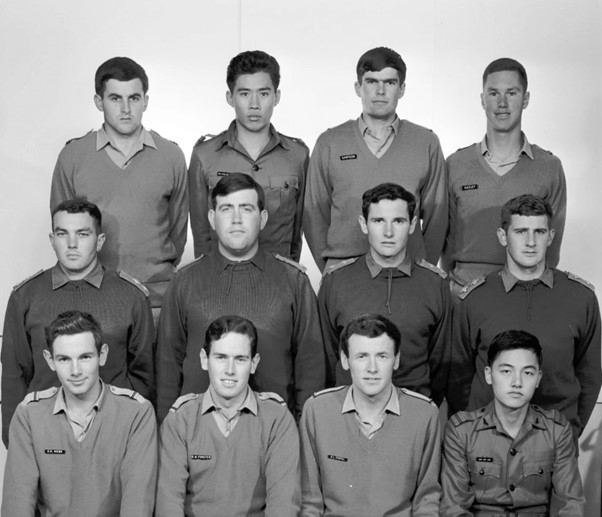
Back row l to r - Jim Barclay, Quah Hock Guan RMAF, Darrell Simpson, Paul Gazely Middle row – NZ Army – John Watson, Cam McIvor, Reg Ellwood, Stu Jameson
Front Row – Dale Webb, Barry Forster, Brian O’Neil, Koh Kia Lim RMAF, (not in photo Peter Garnett)
The ‘Intermediate’ phase followed from 8 Apr 68 until 28 Jun 68 where more advanced pilot skills were learnt including low flying, close formation, night flying, and a weapons camp at Ohakea – at the end of this phase I now had a progressive total of 157 hours on the Harvard. The two remaining NZ Army pilots (Reg Ellwood and Stu Jameson) gained their ‘wings’ at the end of the Intermediate phase and went on to begin their helicopter conversion course at Hobsonville. On 3 Jul 68 all seven RNZAF trainee pilots and one RMAF pilot (Koh Kia Lim) began their ‘Applied’ phase where, after conversion onto the twin-engined DH Devon, emphasis was on instrument flying, night flying and airways flying until 17 Sep 68. A Graduation parade was held at Wigram on 20 Sep 68 where the seven RNZAF pilots, and one RMAF pilot, were presented with their Pilot’s Brevets. A ‘Grad Ball’ was held that night in No 2 Officers Mess, Wigram. I now had a total of 226 hours flying, of which 69 hours were in the Devon.
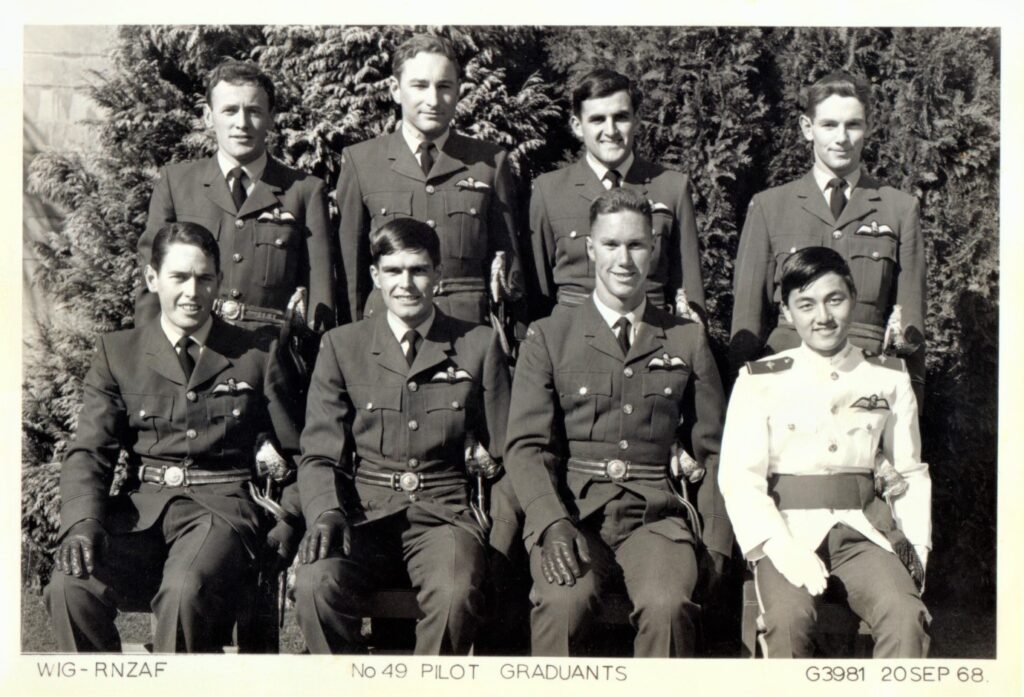
Rear row L to R – Brian O’Neill, Peter Garnett, Jim Barclay, Dale Webb
Front Row – Barry Forster, Darrell Simpson, Paul Gazely, Koh Kia Lim (RMAF)
RNZAF Operational Orientation Course – Seven newly graduated RNZAF ‘wings’ course pilots reported to the Strike Support Unit (SSU) at Ohakea on 30 Sep 68 to begin the Operational Orientation Course (OOC). The purpose of the OOC course was so that newly graduated aircrew would visit all RNZAF operational flying squadrons and receive briefings on the respective squadron roles and tasks, and, where possible, to ride in each of the aircraft types flown by that squadron. We were told that near the end of the three-month OOC course, we would be invited to indicate our personal preference as to which role/squadron we wished to be posted to. I’d already decided it was 75 Sqn Vampire jet fighters for me!
75 Squadron – At Ohakea, we reported to 75 (Vampire) Sqn for briefings on the squadron’s purpose as a jet-conversion unit for pilots, and its operational ‘day-fighter-ground attack’ (DFGA) role. I secured a ride on 30 Sep 68 in Vampire T11 NZ5709 doing ‘cine-quarter’ gunnery attacks, followed by a tail chase and some low flying; and on 15 Oct 68, a second T11 ride doing air-to-air live firing with 20mm guns on a banner towed by another Vampire.
14 Squadron – We then went to 14 Sqn, now based at Ohakea and at that time equipped with the English Electric Canberra B12 medium bomber, and two Canberra T13 trainers that were shared with SSU. The role of 14 Sqn included high-level and medium-level interdiction bombing, close air support, and maritime attack. The squadron deployed annually to exercises from Singapore and other bases in the ‘Far East’ as part of New Zealand’s defence and security obligations.
42 Squadron – We then went to 42 Squadron, at that time equipped with about four Douglas DC3 Dakotas, one or two DH Devons and two NA Harvards. The roles of the squadron included VIP air transport, communications, and Search and Rescue (SAR). I also had a dual-check on 17 Oct 68 in Harvard NZ1056 before enjoying a solo flight on 24 Oct 68 in Harvard Mk2A NZ1013, and a second flight on 24 Oct 68 in Harvard NZ1056. On Tuesday 29 Oct 68 I flew Harvard NZ1013 from Ohakea to RNZAF Base Auckland to land at Hobsonville airfield before commencing the Auckland phase of the OOC course.
3 Squadron – At RNZAF Base Auckland we began our OOC duties on Wednesday 30 Oct 68 with a briefing by No 3 ‘Battlefield Support’ Sqn; the squadron was equipped with a range of aircraft involved in short-range tactical transport (TacT) battlefield support. I had a short ‘famil flight’ on 31 Oct 68 in Bristol Freighter B170 NZ5911 twin-engined transport aircraft at Whenuapai airfield, followed by two passenger flights that same night in Iroquois UH1D NZ3804 helicopter from Hobsonville. A further passenger flight followed on Friday 1 Nov 68 in Iroquois UH1D NZ3801, before a passenger flight on Saturday 2 Nov 68 in Iroquois NZ3802 from Hobsonville, via a refuel at Hamilton, to Waiouru and Ohakea – this to see my wife! I returned to Whenuapai early morning on Monday 4 Nov 68 in a 42 Sqn Dakota that was positioning at Whenuapai before starting the regular inter-base communications ‘shuttle’ – to Ohakea, Wellington, Woodbourne and Wigram. On Tuesday 5 Nov 68 I had a short ‘famil’ ride at Hobsonville in Auster J5 NZ1702, a single-engined fabric-covered light ‘comms’ aircraft, followed by another short ride at Hobsonville in Bell Sioux 47G-3B1A NZ3703 light helicopter.
Parachute training – Back at Whenuapai airfield we began a visit to the Parachute Training Support Unit (PTSU) on Wednesday 6 Nov 68, and on Thurs 7th Nov 68 I flew as a passenger on the ‘Para-Dak’ Dakota DC3 NZ3547 to observe the airborne dispatch of a plane-load of Army parachutists. We then commenced our own parachute training, learning how to ‘hit’ the ground and roll – this done on to mats covering the concrete floor in the PTSU hangar. We then moved to the three-storied dispatch tower located on the side of the sports field, and, while wearing a parachute harness, jumped from the tower and descended on a guide wire before executing a ‘prefect’ para-roll on the ground. After a weekend to partially recover from the many bruises to our hips, knees and ankles, we were back doing more of the dreaded para-roll training before on Wednesday 13 Nov 68 doing an early morning live static-line parachute jump from the ‘Para-Dak’ NZ3547 flying at 1500 feet into the Auckland harbour. We were eventually recovered from the water by one of the Hobsonville Marine Flight launches, but not before I’d got tired of dog-paddling in order to stay afloat so had inflated my ’Mae West’ floatation device. I know we were all very happy that the parachute training was over.
Altitude Pressure Training – The OOC members went to the Defence Environmental Medicine Unit (DEMU), then located in the historic Clark House, on Clark Road, Hobsonville, from Tuesday 12th until Thursday 14th Nov 68. The very talented and widely experienced Officer Commanding (OC) DEMU, Wg Cdr Dr. Len Thompson and his staff delivered three days of interesting and important aviation medicine training: after a day of classroom lectures we progressed to the Pressure Chamber where Dr. Len and staff took us through Bends Screening tests, Hypoxia runs, a Rapid Decompression, and Pressure breathing training. I was then “Cleared to 40,000 feet unpressurised, and 50,000 feet pressurised”. I was very lucky to secure a seat on a 42 Sqn Dakota ‘shuttle’ from Whenuapai to Ohakea on Friday 15 Nov 68 to see my wife for the weekend; and then to have my Ohakea ‘mates’ organise a ride in Canberra T13 NZ6151 jet from Ohakea to Whenuapai early on Monday morning 18 Nov 68.
No 40 Squadron – The OOC course members then visited 40 Sqn that was equipped with five Lockheed C130H transport aircraft, and one DH Devon. The squadron provided air transport support for the NZ Government and the NZ Defence Force including the carriage of freight and personnel on long range flights, Antarctic support, and Tactical resupply operations of troops and equipment delivered to airfields or airdropped by parachute.
No 5 Squadron – The next visit for OOC was to 5 Sqn with their five P3B Orion maritime patrol aircraft engaged in antisubmarine operations, maritime surveillance, and search and rescue operations. We were given extensive briefings on the squadron’s role, and even had to sit an ‘exam’, probably to test whether had been awake during the lectures! We also visited and flew the flight ‘simulator’ which in those days was in effect little more than a part-task procedural trainer. On Friday 22 Nov 68 were taken on a 2.5 hour flight in P3B Orion NZ4205 in which the crew were undertaking a ‘Tactical Exercise’ (TACEX) against a notional submarine, before doing circuits at both Auckland International airport and at Whenuapai.
Adventure training – by very small yacht to Waiheke – As part of the OOC ‘adventure training’ programme, we were taught how to sail small ‘Sun Burst’ yachts in the Hobsonville channel, with its swiftly flowing tidal waters. Two OOC pilots were allocated to each yacht, but my ‘skipper’ with me aboard capsized our wee Sunburst whereupon the mast stuck in the mud and was held there by the swift current. A Marine Flight launch attached a rope and tried to haul the stuck yacht back upright but in doing so, snapped the yacht’s mast. As the mast could not be replaced by the next day, I was assigned to crew on a replacement ‘Idle-along’ yacht, which seemed to be a much more seaworthy craft than the basic dingy-like Sunburst.
After several days of training we sailed those same small yachts, in a strong easterly head-winds, from the Hobsonville marina to pass under the Auckland harbour bridge and then tacked all the way into strong head-winds and incoming tides while bound for Waiheke Island. There we practiced our survival skills by building bivouac shelters before a well-earned overnight sleep – in the open! Next day we tried our fishing and shellfish harvesting skills and having enjoyed little or no success were very glad of the ‘rations’ provided by our safety escorts. Thankfully, on the third day, we rode home to Hobsonville on a Marine Flight launch, towing the yachts behind us!
Escape and Evasion – In December, OOC pilots took part in an ‘Escape and Evasion’ exercise in the Hunua ranges located to the west of the Firth of Thames. The intention was that we would be dropped into the Hunuas by helicopter later in the afternoon where we were to spend an overnight in the bush. On the next morning we were to make our individual or small group ways eastward to some nominated rendezvous (RV) or safe points on the coast, while NZ SAS troops were dispersed to catch and interrogate us anywhere enroute.
So, two No 3 Sqn Iroquois helicopters transported us from Hobsonville to a very remote landing site in the rugged Hunuas; after the choppers had departed we had to individually build bivouacs using a small portion of a parachute in order to provide some protection from the weather while we slept overnight. The only food we had was that normally carried in an aircraft survival kit – like nothing! I remember it was a very, very cold that night so some very hungry young pilots lay huddled close to each other around a small fire trying to keep warm. Sleep was at best only intermittent, so all were awake well before sunrise. We had been told we were not to depart our ‘campsite’ before 6.00am, but I had departed with another pilot before this into the bush before the SAS troopers rushed into the camp and apprehended as many pilots as they could.
With my ‘mate’ we set off on our journey eastward towards the coast, keeping to the steeply clad bush terrain and well clear of the river valley floor below for fear of being caught by the SAS. However, after a disagreement about attacking yet another steep climb, we spilt up and thereafter made our own way to the flatter dairy farm country beyond the heavily bush-covered hills. By now very tired, I slept on the grass in a paddock before continuing my journey to the coast. I then crept northward in the scrub and bushes up the coastline towards a designated RV point – I remember being dive-bombed by a quite a number of noisy nesting Dotterel birds who, I feared, would draw attention to my position and lead to my capture by SAS. However, I was very relieved to arrive at the ‘safe’ RV point without being captured, and there awaited pickup by the event organisers before eventual return to Hobsonville. Mission accomplished!
The end of OOC – As the Escape and Evasion exercise was effectively the end of the OOC we were flown back to Ohakea for ‘debriefs’ about the value of course. I think the general sentiment of the seven newly-graduated pilots was that although some phases of the OOC were interesting and informative, we were in effect ‘marking time’ and would much rather have been posted straight to our assigned operational squadrons to begin our further flying careers. On 13 Dec 68, the final day of the OOC, I was very pleased to be told I was posted to 75 Sqn to fly Vampire jets at Ohakea, commencing in January 1969!
Where to after the OOC? – In closing, and based on my memory of what happened some 58 years ago, I have added the initial roles the seven No 49 Course pilots were posted to:-
Jim Barclay – No 75 (Vampire) Sqn, and then No 75 (Skyhawk) Sqn
Dale Webb – No 75 (Vampire) Sqn and then 42 Sqn (Dakota) Sqn, before No 40 (Hercules) Sqn
Darrell Simpson – No 3 Sqn for helicopter training on the Sioux, then the Iroquois, before later to No 5 (Orion) Sqn
Peter Garnett – No 3 Sqn for helicopter training on the Sioux, then the Iroquois
Paul Gazely – No 42 Sqn Dakotas before No 5 (Orion) Sqn
Brian O’Neill – No 3 Sqn to fly the Bristol B170 Freighter, then later to No 5 (Orion) Sqn
Barry Forster – No 3 Sqn to fly the Bristol B170 Freighter
by Jim Barclay in February 2026
Richard Ketchum
Posted at 23:20h, 09 MarchGood morning Sir, I just received this e-mail this morning and am always happy to see what your upto . How are you and your family doing? My family and I are all doing good.. Have a great year. Rick Ketchum
Jim Barclay
Posted at 09:01h, 02 AprilThank you Richard!
Regards,
Jim
Grahame Allport
Posted at 10:01h, 17 JuneLoved the story, your recall “top notch”. Them were the days.
Jim Barclay
Posted at 11:16h, 17 JuneI’m pleased you enjoyed it! Rolling the hangar doors open to recall things that happened a long ago was an interesting process!
Cheers, Jim